Showing posts with label Germany. Show all posts

Wednesday, May 6, 2015

Chiune Sugihara: Righteous Among the Nations

Chiune Sugihara
Not even counting the fact he was born on January 1st, 1900,  Chiune Sugihara was a pretty cool guy. Early in his career, Sugihara served as Deputy Foreign Minister in Manchuria, and during his time there converted to Christianity. He soon resigned from his position there in protest against the Japanese treatment of the Chinese there. In 1939, Sugihara was assigned to be the vice-consul of the Japanese Consulate in Lithuania. The Japanese did not entirely trust their German allies to fulfill all their promises, and so Sugihara was supposed to keep an eye on both them and the Russians, with whom Japan had been at war just a little while before. After Soviet Russia occupied Lithuania in 1940, the exiled Jews of Lithuania and Poland searched at all of the consulates for visas in order to travel safely from these war-torn areas filled with anti-Semitic militants. Initially, in order to help these refugees, Sugihara attempted to go through the proper channels and was denied multiple times by his superiors to issue visas for anyone except those with money or visas to a destination after their trip to Japan. In July or August of 1940, after consulting his family, Sugihara began to grant visas on his own, against his superior's will, which was a big no-no in imperial Japan. After speaking to Soviet officials, he secured the Jews the ability to travel through the country via the Trans-Siberian Railway at five times the standard ticket price. Sugihara continued writing these visas, reportedly spending 18 to 20 hours a day working on them, until September 4th when he had to leave his post before the consulate was closed.  Of the thousands of visas he had granted, many were to heads of households, who were thus permitted to take their families with them on a single visa. On the night of their departure he and his wife continued writing these visas, and according to witnesses he continued writing visas on the transit from his hotel to the train and while on the train, throwing the visas out the windows to the crowds of refugees. As the time of his departure neared, he started throwing out blank pieces of paper with the consulate seal and his signature on them for people to write out their own visas later. Right before he left Sugihara stood and said “Please forgive me. I cannot write anymore. I wish you the best.” And as he bowed deeply to the refugees gathered before him, someone exclaimed, “Sugihara! We’ll never forget you. I’ll surely see you again!” Incredibly he never received any reprimand or notice from the Japanese government. Sugihara himself wondered about the reaction to the thousands of visas he issued. Many years later, he recalled, "No one ever said anything about it. I remember thinking that they probably didn't realize how many I actually issued." It is estimated that Sugihara issued 6,000 visas, many of which were family visas and accounted for multiple people. Because of his actions, an estimated 40,000 descendants of the Jews he saved are alive today, and Sugihara received the honorific of "Righteous Among the Nations" from Israel for his bravery in saving these Jews from the certain death and horrors of the holocaust, and I believe the title is well deserved. 

Friday, January 23, 2015

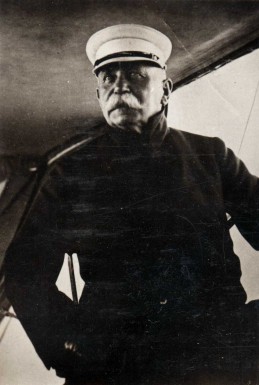
Count Ferdinand von Zeppelin

Zeppelin Aboard his LZ-3 in 1908
The Count is well known for his contributions to the field of aeronautics, and perhaps even more so for his creations: the Zeppelins. An officer in the Prussian Army, Zeppelin was serving as an overseas observer of the Union Army during the American Civil War when he first came across a hot-air balloon. While in Saint Paul, Minnesota, around 1863, Zeppelin rode in a retired observation balloon from the Union Army. Supposedly, this flight was the inspiration for his later interest in Aeronautics. Many years later, in 1874, Zeppelin put an entry into his journal detailing what would later become his masterpiece: a rigidly-framed, aerodynamically flown ship containing one or multiple gas cells inside. While he attempted to install lighter-than-air programs in the Prussian military while he was a general, he could not convince the other ranking members of their usefulness. Because of this, he wasn't able to truly work on his dream until he was forced to retire from the army in 1891. After many struggles, Zeppelin was finally able to begin building his airship design in 1898. It was to be called the Luftschiff Zeppelin 1, or Airship Zeppelin 1. Two years later, on July 2nd, 1890, the over 400 ft long LZ-1 made it's first successful flight, remaining in the air for 20 minutes. Zeppelin's dream was a reality. The innovator would leave behind a legacy that continues strong today, as rigid airships still bearing his basic designs fill the air, and the magic of these lighter-than-air machines fills beholders with wonder.

Wednesday, December 17, 2014

The Spanish Civil War: The Rise of the Forgotten Fascist

Franco Reviewing His Victorious Troops
While it has been argued whether or not Francisco Franco was actually a fascist, it is undeniable that he was a dictator who appeared to enjoy the characteristics often associated with fascism. He possessed an acute sense of patriotism, little to no tolerance for those who disagreed with his political aims, a strong controlling hand over all aspects of his people's lives, and a deep dislike of communism. Either way, there are two things I wanted to focus on about the Spanish Civil War; the first is it's use as a training ground for German and Italian Troops prior to World War II, and the second is the fact that Franco's nation was almost ignored after the Nazi's defeat. Just 3 years before World War II, in 1936, Spain descended into arguably the worst form of violence, a civil war-brother against brother, father against son. The war was between the leftist elements of the relatively new Spanish Republic and the more traditional Nationalists that were often concentrated in the military. Interestingly the Republic forces were backed by the Soviet Union, making one question whether this was a Republic in name only. The Nationalists were backed by both German and Italian forces as they attempted to add another member to the growing club of European ultra-nationalists. The war started after a partially successful coup left the country split between Nationalist and Republic forces. Franco soon found himself in charge of the Nationalist uprising. This is due mainly to the fact that the other senior officers of the rebellion had had previous experiences that left them appearing slightly untrustworthy to many of the hard-core nationalists, as well as the fact that Hitler promised to send all his military support to Franco, and Franco alone. Throughout the war, Hitler and Mussolini both sent troops and arms in order to help the nationalist movement, and this is why the Spanish Civil War is often called a "dress rehearsal" for World War II. There is still some debate about how useful the combat was in training the Fascist troops, but I would simply reason that there were some lessons learned in the years of intense combat. Stalin, on the other hand, attempted to covertly help the Republican forces mainly with supplies; interestingly the arms he shipped were either broken, outdated, or brand new and effective, go figure. Either way, after three years of bloody fighting, Franco had won, just six months before the outbreak of World War II. Now, some state that Hitler and Mussolini were expecting Franco to return the favor and help them during by joining the Axis powers. However Franco refrained from entering the war, and most probably saved his state. Why did he not join his "buddies" in conquering Europe? Perhaps it was because Spain was recovering from the horrors of the war. Perhaps Franco wished to focus on his domestic policy rather than an international war. Whatever the reasons, Franco was able to govern Spain from 1939 until his death in 1975. After the first decade of his rule, the harsh oppression of opposition decreased as the last of Republic support waned. Interestingly, Franco's regime was often ignored following World War II, with some believing that his dictatorship was more favorable than the growing threat of the U.S.S.R. and global communism. Franco's legacy is still controversial to say the least. Some in Spain seem to wipe away any memory of him; renaming streets, monuments, and tearing down statues that are even reminiscent to his era. Others wish to open up the official archives and truly reveal what occurred during those years of change and uncertainty; when ideologies clashed, were tried and often only fell with those that supported them.

Tuesday, November 11, 2014

Veterans Day: Remembering the Armistice

A U.S. Navy Railway Gun

What is today celebrated as a day to remember all the veterans that have served the United States, originally signified the end of the international conflict in the early 20th century. The armistice celebrated November 11th marks the signing of the final armistice of World War I between Germany and the Allied powers. Three days prior to the signing the delegates from Germany were secretly brought across the war zone to a secure location on board  a carriage of Marshall Ferdinand Foch's private train parked in the forest of Compeigne. When the delegates arrived they were given a list of demands and 72 hours to agree. There was no room to actually negotiate during the period, and very little was promised in return by the Allies. Only a few impossible terms were they able to correct, such as the demand that they decommission more submarines than were in their fleet. After three days reviewing the harsh demands, with pressure from Germany for the armistice, the delegation signed at 5:00 AM, November 11th, 1918, ending the fighting. The last shot of the war was fired by the U.S. Navy railway battery number four near Verdun at 10:57:30 AM, timed so it would land far into the German-held territory right before the 11:00 AM cease-fire. Interestingly, no fighting had ever occurred on German soil in the West the entire length of the war. Now the actual terms of peace were not formalized until 6 months later after the Paris Peace Conference at the signing of the Versailles Treaty, which was signed  on the 28th of June, exactly 5 years after the assassination of Archduke Ferdinand (See previous post.) Rejecting President Wilson's 14 points, which the German's were reportedly expecting, the other Allies opted for harsher punishments for Germany, blaming them solely for the war. Many have criticized the Versailles treaty as not being designed to ensure a lasting peace, but is actually one of the reasons for the Second World War.