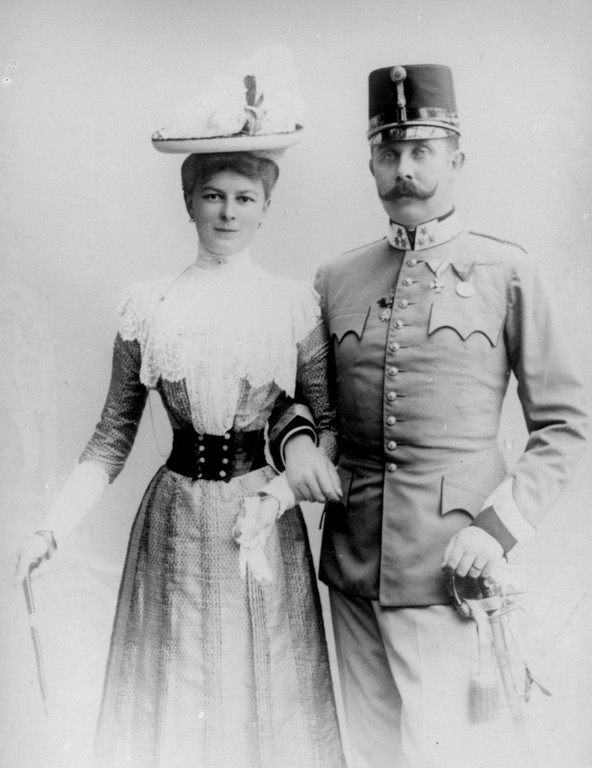
Archduke Franz Ferdinand and his wife, Sophie
One hundred years ago, the assassination of the heir to the Austro-Hungarian throne lit the fuse that caused the world to descend into the "Great War." There wasn't much great about the conflict that cost the lives of over 15 million people. While the growing armament and resentment of the pre-war era is heavily discussed, not many talk about the actual murder of the man and wife whose deaths were used almost as an excuse for the war. The Archduke was heir to the throne of the Austro-Hungarian Empire, a fairly large state that controlled what is now Austria, Hungary, the Czech Republic, and more. In late June of 1914, Franz was on a diplomatic trip to meet with the governor of Bosnia-Herzegovina. Now, there was a lot of ethnic tension in these areas at the time. Nationalism was strong and many of these minorities felt that the Austrians were their unrightful rulers. In this particular area, many of the Serbians in the area felt much closer ties to their Serbian, and even Russian, neighbors than their Austrian governors. One of these Serbians was Gravilo Princip. He was a member of the Black Hand, an organization that basically wanted to unify all Serbians under a single state. They had already been part of assassination attempts before, even attempting to kill the emperor in 1911. On the 28th of June, Princip, along with other Black Hand members, attempted to kill the Archduke and his wife on their way into Sarajevo. One member threw a grenade at their car while they entered the city, but missed, and hit one of the cars behind them, hurting many of the bystanders. The man who threw the grenade ate a cyanide pill and jumped into the river Milijacka in an attempt to avoid capture. However, the cyanide pill was expired and simply made him sick, and the river was only a few inches deep and didn't kill him, and he was soon captured. The other assassins did not have another chance to attack as the car carrying Franz and his wife sped by. After having dinner with the governor and other officials, the Archduke and Sophie decided to visit those wounded in the explosion at the hospital. Unfortunately everyone forgot to tell the driver, who assumed they were still on schedule. Eventually one of the passengers figured out they were going the wrong way and told the driver to turn around. Now Princip, having avoided capture, went to a bar which had a large window that looked out onto the street. He glanced up from his beer and saw the Archduke's car turning around. Seizing the opportunity, he walked outside crossed to the car, and shot both Franz and Sophie. He attempted to take cyanide, but it too was expired; and when that didn't work he tried to shoot himself, but the cyanide made him vomit, allowing the police to subdue him. The Archduke's last words were reported to be "Sophie dear! Don't die! Stay alive for our children!" Unfortunately, Sophie and Franz both died shortly thereafter, as they were being rushed to help. After the assassination, much rumor occurred about the incident. Austria-Hungary and Serbia were already at odds, and the murder by the Serbian nationalists did anything but help. A month after the incident, an ultimatum was delivered to the Serbians. Franz and Sophie, the young parents were arguably the first causalities of this, the Great War.

.jpg%2F220px-Blenkinsop%27s_rack_locomotive%252C_1812_(British_Railway_Locomotives_1803-1853).jpg&container=blogger&gadget=a&rewriteMime=image%2F*)
